
1st Edition vs Unlimited: Understanding Pokemon Wizard Card Editions
Everything you need to know to recognize, evaluate and invest in 1st Edition Pokemon cards from the Wizards of the Coast era
Introduction: why editions matter so much
In the world of vintage Pokemon cards, few details have as much impact on value as a small symbol printed in black on the left side of the card. That symbol is the 1st Edition stamp, and its presence can multiply a card's price by 5, 10, or even 50 depending on the case. For any collector or investor interested in cards from the Wizards of the Coast era (1999-2003), understanding the difference between 1st Edition and Unlimited is not a mere detail: it is fundamental knowledge.
The Wizard era corresponds to the period when Wizards of the Coast held the Pokemon TCG license outside of Japan. During those years, each expansion was printed in two distinct print runs: a limited first print run bearing the 1st Edition stamp, followed by an "Unlimited" print run produced in much larger quantities to meet demand. This distinction between the two editions has become, over time, one of the most decisive criteria for evaluating a card's rarity and value. For a complete overview of every set from this era, see our Wizard block guide covering all expansions from 1999 to 2003.
In this comprehensive guide, we will cover how to visually identify a 1st Edition card, list all the expansions concerned, analyze the concrete impact on prices, identify traps to avoid when purchasing, and understand the role of certification in this market. Whether you are starting your collection or looking to refine your expertise, this article is for you.
Recognizing a 1st Edition card
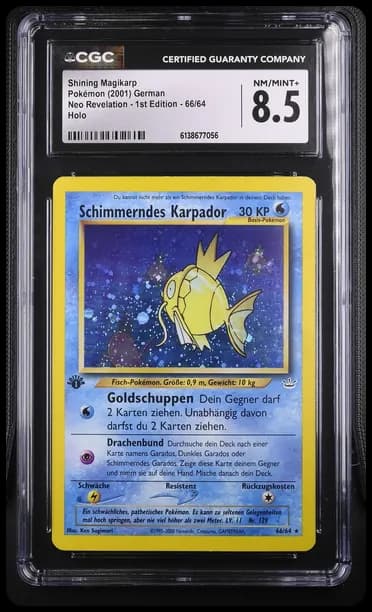
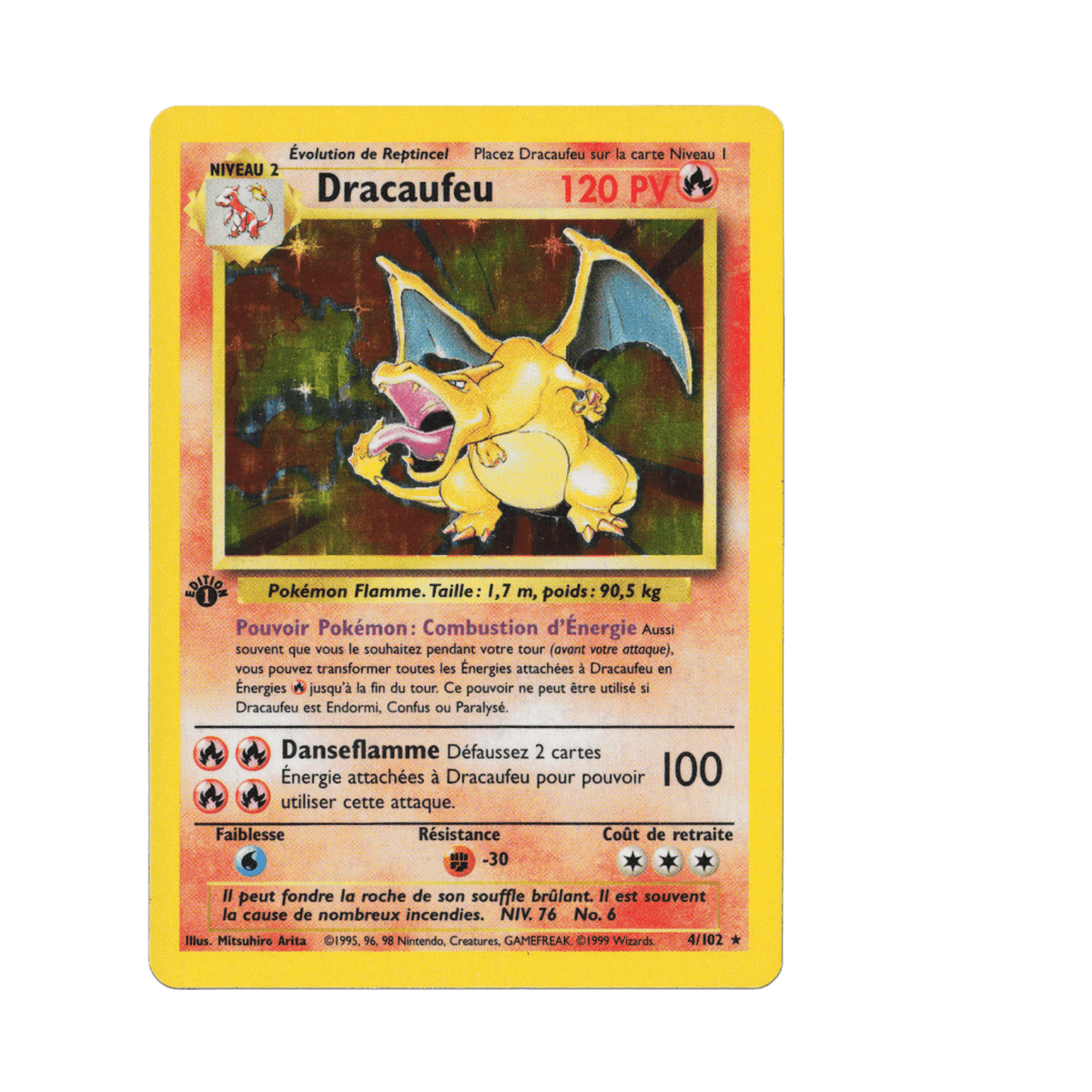
Identifying a French 1st Edition card is relatively straightforward once you know where to look. The distinctive marking is located on the left side of the card, just below the illustration and to the left of the Pokemon's name. It consists of a small logo featuring a "1" enclosed in a circle, accompanied by the text "Edition 1" (on French versions) or "1st Edition" (on English versions).
On French cards published by Wizards of the Coast, this stamp is printed in black, cleanly and sharply defined. It is precisely positioned between the left edge of the illustration frame and the text area of the card. Its size is relatively small (about 5 mm in width), but it is perfectly readable to the naked eye.
Some additional details to observe on French WOTC cards:
- The stamp must be clean and even. A blurry, off-center, or smudged stamp may be a sign of a counterfeit.
- The color is a deep, uniform black. Fake stamps often have a slightly grayish or glossy black.
- The logo is integrated into the card's printing. It should not appear as a surface addition. When touched, you should not feel any raised texture.
- The positioning is identical on all cards from the same expansion. Comparing with other 1st Edition cards from the same set can help verify authenticity.
For collectors of Base Set cards in particular, it is important to note that the "Shadowless" distinction (no shadow on the right edge of the illustration frame) only exists on English cards. French 1st Edition Base Set cards do not have this feature: they all display a shadow on the frame, which is normal and does not call into question their first print run status.
Which expansions had a 1st Edition?
All expansions from the Wizards of the Coast era received a 1st Edition print run, with the notable exception of Base Set 2 (which was already a reprint). Here is the complete list of French expansions concerned, with their approximate release dates in France:
| Expansion | France release (approx.) | Number of cards |
|---|---|---|
| Base Set | October 1999 | 102 |
| Jungle | October 1999 | 64 |
| Fossil | January 2000 | 62 |
| Team Rocket | July 2000 | 83 |
| Gym Heroes | November 2000 | 132 |
| Gym Challenge | March 2001 | 132 |
| Neo Genesis | April 2001 | 111 |
| Neo Discovery | September 2001 | 75 |
| Neo Revelation | January 2002 | 66 |
| Neo Destiny | May 2002 | 113 |
Among these expansions, some are notoriously rarer in French 1st Edition than others. The final sets in the series, notably Neo Revelation and Neo Destiny, were printed in particularly small quantities in French. The market was already in decline at that time, meaning that the 1st Edition print runs of these expansions are among the rarest and most sought-after today. To explore available Neo cards, check out our dedicated Neo expansions page.
Note that the e-Card expansions (Expedition, Aquapolis, Skyridge) and promo sets did not have a 1st Edition version in French, as the distinction was abandoned after Neo Destiny.
Impact on prices: considerable gaps
The price difference between a 1st Edition card and its Unlimited equivalent can be spectacular. The multiplier varies depending on the card, the expansion, and the rarity, but the orders of magnitude are impressive. Let us take a few concrete examples to illustrate this impact.
Base Set Charizard
The most emblematic example remains the holographic Base Set Charizard. In the French 1st Edition version, a copy in very good condition (ungraded) trades for around 10,000 euros and above. The same card in the Unlimited version sits between 500 and 1,500 euros depending on condition. The multiplier is therefore approximately 7 to 20 times in favor of the 1st Edition. For a detailed analysis of the price evolution of this iconic card, see our article Charizard 1st Edition Price Evolution.
Rare holos from the first sets
For other rare holographics from the Base Set, Jungle and Fossil, the multiplier generally sits between 5x and 15x. A French 1st Edition Blastoise is worth approximately 2,000 to 5,000 euros, compared to 200 to 600 euros in Unlimited. A 1st Edition Venusaur follows a similar trajectory. Less popular holographics (Zapdos, Machamp, etc.) show more modest multipliers, around 3x to 8x.
Common and uncommon cards
The impact of the edition is felt even on the most modest cards. An Unlimited Base Set common is worth only a few cents, while the same card in 1st Edition can be worth between 2 and 10 euros. For uncommons, 1st Edition prices climb to between 5 and 30 euros. The relative multiplier is therefore even more impressive on low-rarity cards: we are sometimes talking about 20x to 50x the price of the Unlimited version.
Neo and Team Rocket expansions
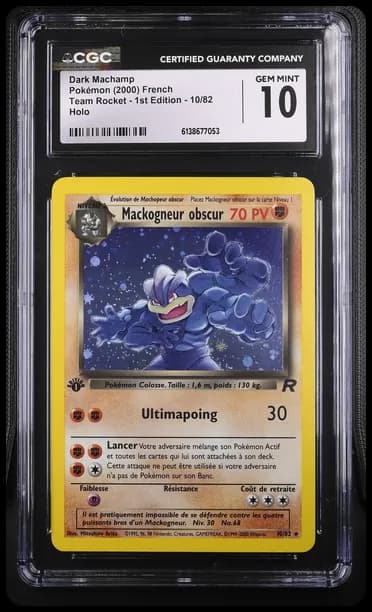
French Team Rocket 1st Edition cards are particularly sought after. The 1st Edition holographic Dark Charizard is one of the most coveted cards from this expansion, with prices that can exceed 3,000 euros in good condition. On the Neo side, the Shining cards from Neo Destiny in 1st Edition reach staggering heights: the French 1st Edition Shining Charizard is a true Holy Grail that can exceed 5,000 euros even in average condition.
Traps to avoid when purchasing
The 1st Edition card market is unfortunately not immune to fraud attempts. Here are the main traps to be aware of in order to protect yourself.
Fake 1st Edition stamps
The most common trap is adding a fake 1st Edition stamp to an Unlimited card. Counterfeiters use ink stamps or prints to add the logo to a card that did not originally have one. To detect this fraud: examine the stamp under a magnifying glass. A genuine stamp is integrated into the card's print matrix (visible under magnification as regular dots). A fake stamp appears as an additional layer, often with a slightly different ink or a glossy/matte appearance that does not match the rest of the card.
Resealed boosters
Some sellers open 1st Edition boosters, replace the valuable cards with Unlimited ones, then reseal the packaging. If you are purchasing sealed 1st Edition boosters, carefully inspect the packaging seals. Original seals are regular and uniform. A reseal generally leaves visible traces: irregular sealing, glue marks, or slight deformation of the packaging.
The Shadowless / 1st Edition confusion
Complete counterfeits
Beyond fake stamps, there are complete counterfeits of 1st Edition cards. These fakes can sometimes be difficult to detect for an untrained eye. Telltale signs include: inferior print quality (slightly different colors, less sharp text), paper with a different feel (too smooth or too rough), absence of the black intermediate layer visible on the card's edge, and a slightly different weight. When in doubt, the best protection remains purchasing cards already certified by PSA or CGC.
Grading and edition: a complex relationship
Certification by an organization like PSA or CGC adds an additional layer of analysis. The card's edition is systematically mentioned on the grading case, which reinforces buyer confidence and facilitates identification. For a detailed comparison of the two main organizations, see our article PSA vs CGC: which certification to choose?
During grading, PSA and CGC identify and mention the edition directly on the case label. A 1st Edition card will be clearly labeled "1st Edition" (PSA) or "1st Edition" (CGC), while an Unlimited card will bear the "Unlimited" designation. This verification by a trusted third party is one of the best safeguards against fake stamps.
When a high-grade Unlimited is worth more than a low-grade 1st Edition
A point often overlooked by beginners: an Unlimited PSA 10 copy can be worth more than a 1st Edition PSA 7 for certain cards. For example, an Unlimited Base Set Charizard PSA 10 trades between 3,000 and 6,000 euros, while a French 1st Edition Charizard PSA 6 or PSA 7 can fall within the same range. The grade therefore has a considerable impact that can sometimes offset the edition difference.
However, at the same grade, the 1st Edition always retains a significant premium. A PSA 10 1st Edition will always be infinitely more expensive than a PSA 10 Unlimited. The combination of 1st Edition + high grade remains the absolute pinnacle in terms of value and desirability.
1st Edition as a long-term investment
1st Edition cards from the Wizard era have established themselves as fully-fledged investment assets in the collectibles market. Their supply is strictly limited (no more cards will ever be printed with this stamp), while demand continues to grow, driven by nostalgia and the expanding collector market. To learn more about investment strategies for Pokemon cards, we recommend our guide Investing in Pokemon Cards in 2026.
Which sets to prioritize?
In terms of investment potential, here are the expansions to watch as a priority:
- Base Set 1st Edition: The most iconic set, with the broadest demand. The holographics (Charizard, Blastoise, Venusaur) are safe bets. Complete lots of 1st Edition commons and uncommons are also an interesting segment.
- Team Rocket 1st Edition: The "Dark" versions of popular Pokemon (Dark Charizard, Dark Gyarados) benefit from a strong visual identity and a dedicated collector community.
- Neo Destiny 1st Edition: The Shining cards from this expansion are among the rarest of the entire Wizard era. French 1st Edition print runs are extremely low, making them pieces with strong revaluation potential.
- Gym Heroes and Gym Challenge 1st Edition: Often undervalued compared to other Wizard sets, these expansions offer a more accessible entry point with catch-up potential.
Advice for investors
First, prioritize PSA 8 or higher graded copies for rare holographics. Higher grades hold their value better over time and are easier to resell. Second, French 1st Edition versions are currently undervalued relative to their actual rarity, which represents an opportunity for patient investors. Third, diversify across multiple sets and rarity levels rather than concentrating your budget on a single card. Finally, adopt an investment horizon of at least 5 to 10 years to maximize your chances of capital gains.
How to authenticate a 1st Edition stamp: a guide for English cards
The English 1st Edition market, with its higher price points, attracts a proportionally higher volume of counterfeiting attempts. Authenticating a 1st Edition stamp requires careful examination of several physical characteristics that counterfeiters consistently struggle to replicate accurately.
The dot pattern test
Genuine Pokemon cards are printed using a CMYK halftone process, which creates a characteristic pattern of colored dots visible under 10x magnification or higher. On an authentic 1st Edition stamp, the black ink of the "1" and the surrounding circle is composed of the same dot matrix pattern as the rest of the card's printed elements. The dots are evenly spaced, uniformly sized, and align with the overall print registration. A fake stamp, applied after printing, will either show solid ink with no dot pattern, a dot pattern at a different angle or density from the rest of the card, or irregular ink distribution visible as blotching or pooling at the edges of the stamp.
The light reflection test
Hold the card at an angle under a bright light source. On a genuine 1st Edition card, the stamp area reflects light identically to the surrounding card surface because the ink was laid down during the same printing pass. A fraudulent stamp often shows a different sheen -- either more glossy or more matte than the surrounding area. This difference can be subtle, so compare against a known authentic 1st Edition from the same set if possible.
The Shadowless factor: unique to English Base Set
English Base Set cards present a unique authentication advantage that no other language printing shares. Genuine English 1st Edition Base Set cards are always "Shadowless" -- they lack the drop shadow on the right side of the card's artwork window. If someone presents an English Base Set card with both a 1st Edition stamp and a shadow border, it is definitively a fake. The shadow was added in the Unlimited print run. This is a binary, unforgeable indicator that makes English 1st Edition Base Set cards somewhat easier to authenticate than their foreign-language equivalents.
Weight and thickness verification
Genuine WOTC-era Pokemon cards weigh approximately 1.7 to 1.8 grams and have a consistent thickness. Complete counterfeits often deviate slightly in weight, either heavier due to thicker card stock or lighter from lower quality paper. A precision scale accurate to 0.1 grams can help flag suspicious cards. Additionally, authentic cards reveal a black layer when viewed edge-on -- this is the core layer of the card stock sandwiched between the front and back printed layers. Counterfeits frequently lack this black core, showing instead white or gray core material.
Professional authentication services
When significant money is at stake, professional authentication removes all doubt. PSA, CGC, and Beckett (BGS) all verify the edition as part of their grading process. The card's edition is printed directly on the encapsulation label. A PSA-graded card labeled "1st Edition" has been examined by trained professionals who verify the authenticity of the stamp as part of their evaluation. For high-value transactions involving raw cards, verifying the certification number on the official PSA or CGC website can help confirm a graded card's authenticity. In the English-speaking collector community, forums such as the PokeBeach community, the r/PokemonTCG subreddit, and the Elite Fourum also serve as crowd-sourced authentication resources where experienced collectors can help identify suspicious stamps.
1st Edition market trends: 2020 to 2026
The English 1st Edition market has undergone dramatic shifts over the past six years, and understanding these cycles is essential for any collector or investor making decisions today.
The 2020-2021 boom
The period from late 2020 through early 2021 saw an unprecedented explosion in vintage Pokemon card prices, driven by a perfect storm of factors. The COVID-19 pandemic confined millions of adults at home, triggering intense nostalgia for childhood hobbies. High-profile purchases by celebrities and influencers -- most notably Logan Paul's approximately $200,000 1st Edition Base Set box opening in October 2020 and rapper Logic's record-breaking $220,574 Charizard PSA 10 purchase -- brought mainstream media attention to the hobby. During this 18-month window, 1st Edition Base Set Charizard PSA 10 prices surged from roughly $55,000 to $420,000 at auction in March 2022. Nearly every WOTC-era 1st Edition card saw its value multiply by three to ten times.
The 2022-2023 correction
Following the euphoria came an inevitable correction. Rising interest rates and a broader pullback in alternative assets (NFTs, crypto, memorabilia) contributed to a cooling market. 1st Edition Base Set Charizard PSA 10 prices retreated to approximately $200,000 to $250,000. Lower-tier 1st Edition cards experienced steeper percentage declines, with some Jungle and Fossil holographics giving back 40 to 60 percent of their pandemic-era gains. This correction shook out speculative buyers and YouTubers who had entered the market purely for content creation, leaving the market in stronger hands.
The 2024-2026 stabilization and recovery
Since mid-2024, the 1st Edition market has shown clear signs of stabilization and selective recovery. Several key trends have emerged. First, PSA 10 specimens of iconic cards (Charizard, Blastoise, Venusaur) have firmed up and begun a gradual upward trajectory, with auction prices consistently meeting or exceeding estimates. Second, the mid-tier market -- cards graded PSA 7 to PSA 9 -- has become the most active segment, as collectors priced out of gem-mint copies settle for excellent-condition alternatives. Third, sealed 1st Edition booster packs have proven to be the most resilient asset class, with individual 1st Edition Base Set packs consistently selling above $10,000 regardless of broader market conditions.
What the data suggests going forward
Several structural factors support long-term appreciation of English 1st Edition cards. The supply is permanently fixed -- no more will ever be printed. Population reports from PSA show that grading submissions for WOTC-era cards have plateaued, meaning the supply of high-grade examples is approaching its practical ceiling. Meanwhile, the Pokemon brand itself has never been stronger commercially, with the Scarlet and Violet TCG era introducing millions of new players, some of whom inevitably develop an interest in vintage cards. The demographic tailwind of millennials entering their peak earning years (ages 30 to 42 in 2026) continues to drive demand from buyers who grew up with the original 151 Pokemon and now have the disposable income to acquire the cards they could not afford as children.
Conclusion: 1st Edition, the standard of excellence
The 1st Edition Pokemon card represents the absolute Holy Grail for Wizard era collectors. This small stamp, a testament to the very first print run of an expansion, confers upon the card a rarity and prestige that nothing can equal. The price gaps with Unlimited versions, often in the range of 5x to 50x, attest to the importance the market places on this distinction.
But as we have seen throughout this article, knowledge is the collector's best weapon. Knowing how to recognize a genuine 1st Edition stamp, understanding the specifics of French cards (notably the absence of the Shadowless distinction), avoiding counterfeiter traps, and understanding the relationship between edition and grade: these are the skills that separate the savvy buyer from the vulnerable novice.
Whether you are a nostalgic collector seeking to reclaim the cards of your childhood in their most prestigious version, or an investor looking for alternative assets with strong potential, 1st Edition cards from the Wizard era offer a fascinating, structured, and constantly evolving market. The key is to take the time to inform yourself, compare, and never rush into a purchase without the knowledge needed to evaluate what you are buying.
Read next
 GUIDES
 GUIDES
 GUIDES